Written and medically reviewed by Dr. Raymond Su Wei Siong, who leads implant treatment at Lau Dental
Published · Last updated · 11 min read
Bone grafting for dental implants rebuilds jawbone that has thinned, so there is enough of it to hold an implant securely. At our Sri Petaling clinic it starts from RM400 per site, and it adds roughly three to nine months to the treatment before the implant itself can go in.
It is usually the part of an implant plan that patients did not see coming — you arrive expecting one procedure and leave having been told you need two, with months in between. This guide covers what that actually involves: how much it hurts, how long you wait, what the price depends on, and when a graft can be avoided altogether.
The short answer
| Question | Short answer |
|---|---|
| Cost | From RM400 per site with us; more for extra sites or complex rebuilds |
| Does it hurt | Not during. Afterwards, similar to an extraction; worst on day 2–3 |
| Healing before the implant | 3–4 months for a small graft, 6–9 for a sinus lift |
| How long it lasts | Permanently — your own bone replaces the graft material |
| Can it be avoided | Sometimes — see section 3 |
| Success rate | High, and highest in non-smokers with controlled general health |
What a bone graft actually is
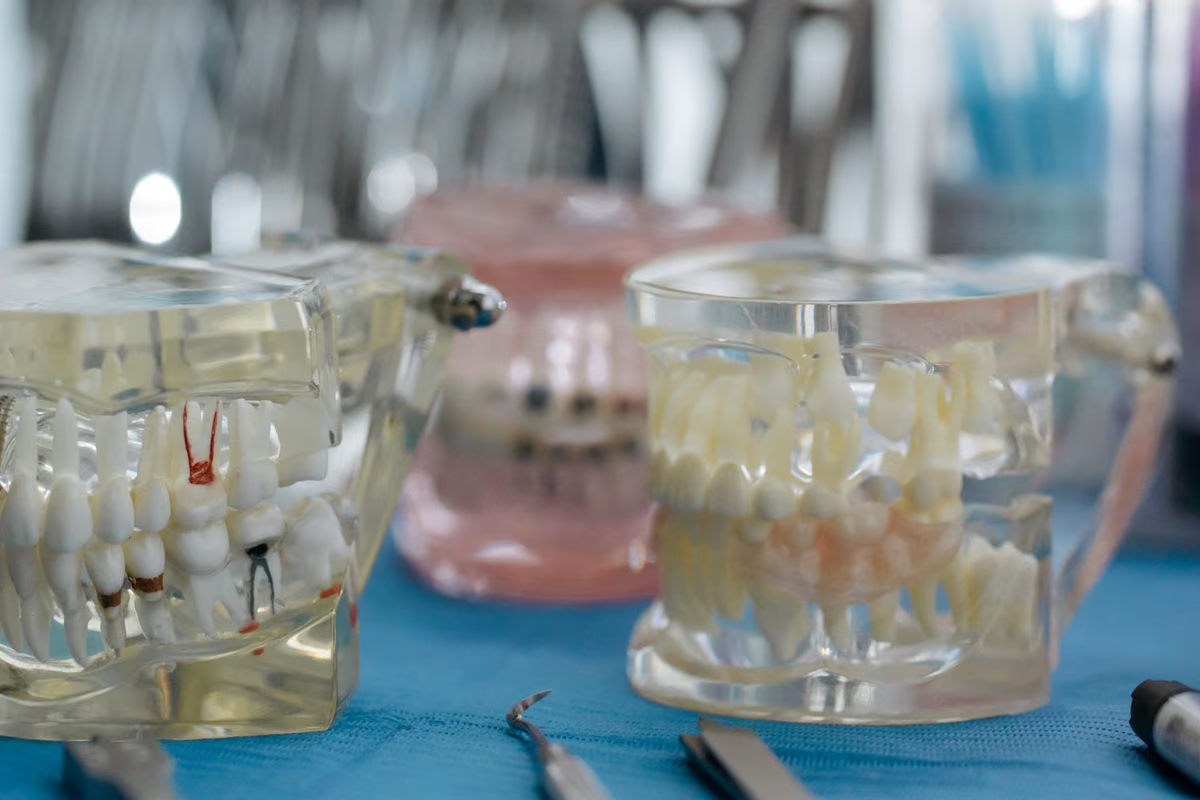
Jawbone exists to hold teeth. Take a tooth out and the bone around that socket stops being used, so the body gradually reclaims it — fastest in the first year, then more slowly for the rest of your life. Wait long enough after an extraction and there is no longer enough bone to anchor an implant.
A graft places material into the thin area to rebuild it. The material is a scaffold rather than a permanent filler: over several months your own bone grows through it and replaces it. That is why a successful graft lasts for life — what ends up holding the implant is your bone, not the graft.
The material itself is usually processed bone mineral or a synthetic substitute, sometimes bone taken from elsewhere in your own jaw. Patients often ask which is best; in practice the choice follows the size and site of the defect, and all the commonly used options are well documented in the published literature.
Do you actually need one?
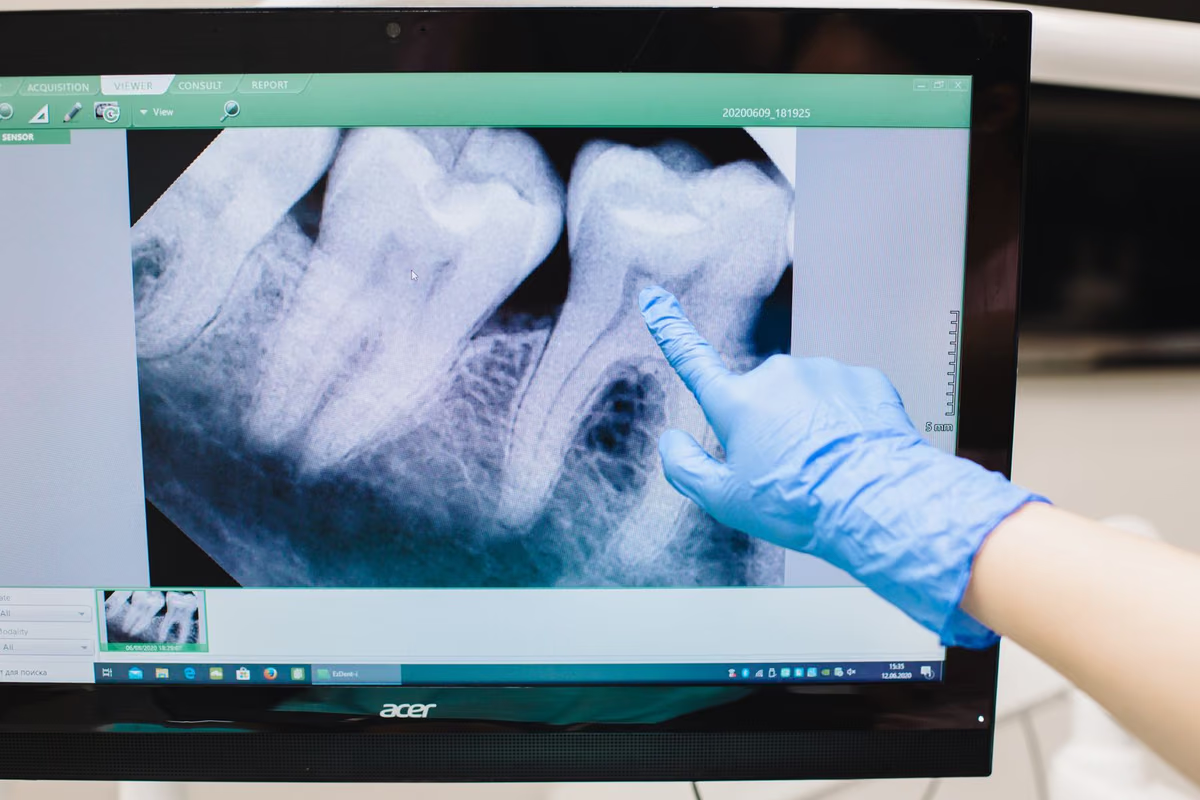
Only a 3D CBCT scan answers this. Bone height and width cannot be judged by looking, and a tooth that has been missing for years can sit above bone that is far thinner than the gum suggests. The usual reasons a graft is recommended:
- The tooth has been gone a long time and the ridge has narrowed
- Gum disease destroyed bone around the tooth before it was lost
- Upper back teeth, where the sinus sits low and leaves little height — this is where a sinus lift comes in
- The socket is being preserved at the time of extraction, to prevent the shrinkage rather than fix it later
And the ways a graft is often avoided. Placing an implant soon after extraction, before the bone has a chance to shrink, sidesteps many grafts entirely. Shorter or narrower implants work where height is limited. Tilting the rear implants — the principle behind All-on-4 — reaches denser bone further forward and is specifically designed to avoid grafting. If you have been told you need a graft, it is reasonable to ask whether any of these apply to your case.
The types, and why quotes vary so widely
This is the part that confuses people most. “Bone graft” covers procedures that differ enormously in scale, and clinics quote all of them under the same two words. Two accurate quotes can be ten times apart because they are describing different operations:
| Procedure | What it involves | Healing |
|---|---|---|
| Socket preservation | Material placed into the socket at the time of extraction. The smallest and cheapest option | 3–4 months |
| Ridge augmentation | Rebuilding width or height on a ridge that has already narrowed | 4–6 months |
| Sinus lift (crestal) | Lifting the sinus floor through the implant site. Less invasive of the two | 4–6 months |
| Sinus lift (lateral window) | Access through the side of the jaw for larger gains. The biggest of the four | 6–9 months |
So when you are comparing clinics, the useful question is not “how much is a bone graft” but which of these am I being quoted for, and how many sites. A quote in the hundreds and a quote in the thousands may both be honest.

Does it hurt?
Not during. The site is fully numbed with local anaesthetic, so what you feel is pressure and vibration rather than pain. Patients who are anxious about the procedure are usually more comfortable than they expected.
Afterwards is where the honest answer matters. Expect soreness and swelling closer to a tooth extraction than to anything dramatic:
- Days 1–3 — discomfort and swelling peak, usually around day two
- Days 4–7 — noticeably easing; most people are back to normal routines
- Days 7–10 — soreness largely gone
Standard over-the-counter painkillers are normally enough. A lateral-window sinus lift is more uncomfortable, and for longer, than a small socket graft — worth knowing which one you are having before you plan your week.
For the first few days: no smoking, nothing hot, no rinsing vigorously, no straws, and no poking at the site. Smoking is the one that matters most — it meaningfully raises the chance the graft fails.

How many months it adds
This is the cost most patients underestimate, and it is measured in time rather than ringgit. The graft has to mature into real bone before an implant can be anchored in it:
- 3–4 months after a small socket graft
- 6–9 months after a sinus lift or larger augmentation
- Then the implant itself needs a further 3–6 months to integrate before the crown goes on
Added together, a case needing a sinus lift can run beyond a year from first surgery to finished tooth. That is not a sign anything is wrong; it is simply what biology takes. The gum closes over within weeks and the area looks healed long before it is ready — which is why we scan rather than judge by eye.
There is an upper limit worth knowing too. If an implant is not placed within roughly a year of the graft, the rebuilt bone can begin to resorb again, because nothing is loading it. Grafting and then postponing indefinitely wastes the work.
Signs something has gone wrong
Most grafts heal without incident. When one does not, the signs are usually clear and the timing is the giveaway — normal recovery improves day by day after the first 48 hours. Anything moving the wrong way deserves a call:
- Pain that worsens after the first week rather than easing
- Swelling still increasing beyond day three, or not settling by day ten
- A persistent bad taste, or discharge from the site
- Granules of graft material visibly coming away
- Gum that will not close over the area
- Fever, or swelling spreading into the cheek or neck
Phone the clinic rather than waiting for your scheduled review. An infection caught in its first days is often treatable with the graft still saved; the same infection two weeks later usually is not. Patients routinely apologise for calling — nobody should.
What it costs in Malaysia
At our Sri Petaling clinic, bone grafting and sinus lift procedures start from RM400 per site. That is the figure for one straightforward site: it rises with the number of sites being grafted and with the complexity of the rebuild, so a socket graft at the time of an extraction sits at the bottom of the range and a lateral-window sinus lift well above it.
For context, published Malaysian figures for bone grafting commonly run from around RM1,500 into five figures. That gap is smaller than it looks — those numbers usually describe a complete procedure across several sites, or a more complex rebuild, while ours is the per-site starting point. It is exactly why the only useful comparison between clinics is which procedure, and how many sites, rather than the headline number.
Two costs sit alongside it that are worth budgeting for from the start:
| Item | Our price |
|---|---|
| Bone graft / sinus lift | From RM400 per site |
| 3D CBCT scan — decides whether a graft is needed at all | RM350 |
| Dental implant with crown, placed afterwards | From RM7,000 |
| Consultation | RM30, waived if you start treatment the same day |
Ask any clinic to quote the graft separately from the implant rather than as one bundled figure. It is the single most common reason an implant quote grows after treatment has started — and it is entirely avoidable by asking before anything is booked. Our implant cost guide covers what else should already be inside a quote, and everything we charge is on the published price list.
You can check that whoever treats you is registered with the Malaysian Dental Council before starting, and general oral health guidance for Malaysia is published by the Ministry of Health.
Finding out whether you need one
A CBCT scan settles it in one appointment — bone height and width either support an implant or they do not, and if they do not, it shows by how much. Our dental implant treatment page covers how the whole process runs, and the consultation is RM30, waived if you begin treatment the same day.
This article is for general information and is not a substitute for a clinical assessment. Healing times and risks vary between patients; suitability, duration and cost are individual and confirmed only after examination. Back to top